
Introduction
The University of El Oued is actively and effectively committed to advancing Sustainable Development Goal 6 (SDG 6), which focuses on sustainable water management and ensuring the availability of sanitation services for all. Given the university’s location in a desert environment characterized by water scarcity, its efforts are intensified to adopt sustainable and innovative practices in infrastructure, direct scientific research toward practical solutions, and enhance community awareness. This report provides a detailed overview of the university’s key efforts and achievements in this domain.
1. Research Contribution to Water Security
The university utilizes its research expertise to generate sustainable solutions that align with regional water challenges.
A. Water Desalination and Solar Distillation Research
In 2024, researchers at the University of El Oued produced high-impact studies focusing on sustainable water desalination technologies. Their work explored innovations in solar still design—such as the use of nanocoatings, evacuated tube systems, and thermal energy storage—to enhance freshwater yield and efficiency under arid Saharan conditions. This research contributes to the development of low-cost, renewable-energy-based solutions to global water scarcity challenges.
B. Wastewater Treatment and Pollution Control
The University of El Oued also contributed to applied research in wastewater treatment and pollution mitigation. Studies focused on the removal of organic dyes and heavy metals from industrial effluents using nanocomposites (such as Ag@Fe₃O₄ and MgO@SnO₂), as well as assessing the performance of wastewater-garden systems in Southern Algeria. These investigations directly support SDG Target 6.3 by developing eco-friendly technologies for clean water recovery and environmental protection.
C. Groundwater Quality and Sustainable Management
Complementary research involved assessing groundwater quality and its sustainable extraction in the Oued Souf region. Scientists used pollution indices and geochemical analysis to evaluate the balance between rising groundwater levels and agricultural practices, highlighting sustainable water management strategies in semi-arid zones. This research contributes to evidence-based policy formulation and regional planning for safe and equitable access to clean water.
2. Infrastructure Practices and Conscious Water Use
The university is taking practical steps to rationalize water consumption across its infrastructure and aesthetic landscaping.
A. Wastewater Management and Pollution Prevention
The university emphasizes wastewater management by providing students with practical exposure through field trips to local treatment facilities (such as Kouinine and Touggourt stations). These visits allow students from the Hydraulics Department to gain practical insights into every stage of water treatment. Furthermore, in collaboration with regional authorities, the university establishes protocols for handling laboratory waste and maintenance procedures to ensure that activities do not affect water quality, and provides spill response training. The Hydraulics Department offers specialized consultation to local water institutions on pollution prevention strategies.
B. Water-Conscious Building Standards (6.3.4)
The university’s continuous program for rehabilitating university residences, supervised by the Head of the Monitoring and Coordination Department (Mouladi Chouchani), includes close monitoring of work to ensure timely completion. The university assumes that these rehabilitation projects involve implementing standards aimed at minimizing water use in buildings through the installation of water-saving fixtures, as part of its efforts to reduce the operational water footprint.
C. Water-Conscious Landscaping
The university is committed to landscaping practices that significantly reduce water consumption, which is vital in the desert climate:
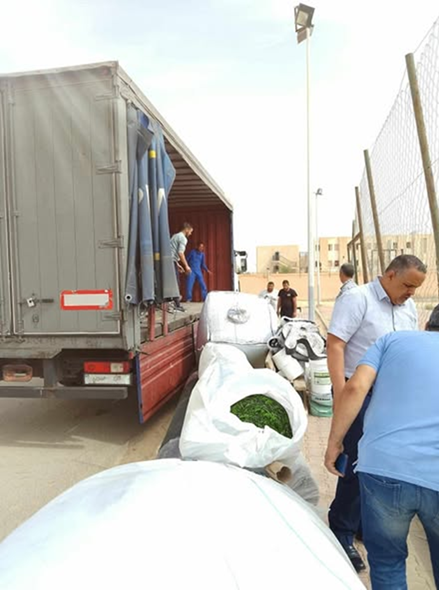
Artificial Turf Installation: In a direct and practical water-saving measure, the decision was made to cover the stadium at Moussaoui Mabrouk University Residence with artificial turf, completely eliminating the need for regular irrigation and water maintenance.
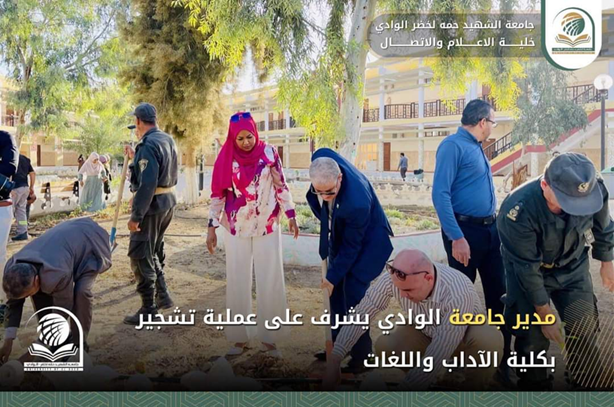
Drought-Tolerant Tree Planting Campaigns: The University Director, Professor Omar Ferhati, oversaw a tree planting operation at the Faculty of Arts and Languages, which involved planting saplings of ornamental, drought-tolerant species such as Turkish Jasmine, Vinca, Bougainvillea, Tecoma, and Dodonaea. This effort ensures the campaign proceeds within the University Environment Improvement Program with minimal irrigation requirements.
D. Free Drinking Water Provision
To promote health and sustainability, the university provides free drinking water for students, staff, and visitors through dispensers and water fountains distributed across campus facilities. This initiative supports hydration and contributes to reducing the use of disposable plastic bottles, aligning with sustainable water consumption practices.
3. Community Collaboration and Awareness
The university acts as an expertise hub and a strategic partner to strengthen regional water security.
3.1 Cooperation on Water Security and Promoting Conscious Use
The university hosted a crucial event linking scientific research with community development and water security:
The TIMSA’24 International Forum on Technology and Innovation for Modernizing Desert Agriculture: The Governor of El Oued Province (Larbi Bahloul) opened this forum, organized by the Higher School of Desert Agriculture. This forum serves as strong evidence of multi-level cooperation (local, regional, and national) on water security, bringing together government representatives (the Governor and former ministers) and leaders, researchers, farmers, and economic partners.
Thematic Focus: The forum addressed key issues, notably soil and water management and solar-powered irrigation methods, crucial for modernizing agriculture in desert regions.
Sustainable Extraction and Awareness: By focusing on “Innovation for Modernizing Desert Agriculture,” the forum effectively promotes technologies that ensure sustainable water extraction in farms and encourages conscious water usage among the broader community, especially the agricultural sector.
Conclusion
The University of El Oued demonstrates a comprehensive and multi-faceted commitment to achieving SDG 6. By linking pioneering scientific research in desalination and wastewater treatment with tangible operational measures (such as artificial turf installation and building rehabilitation), the university is taking significant steps toward reducing its water footprint. Furthermore, the pivotal role of the Hydraulics Department as a center of expertise, coupled with the organization of major international forums like TIMSA’24, reinforces the university’s role as a key partner for government and the private sector in enhancing regional water security and developing sustainable solutions that serve both the campus and the wider community in a resource-scarce region.