
University of El Oued
Introduction
The University of El Oued, Algeria, demonstrates a sustained institutional commitment to environmental sustainability, actively contributing to the global objectives of Sustainable Development Goal 14 (SDG 14), “Life Below Water.” This report details the key academic, research, and strategic initiatives implemented by the University, establishing a robust framework for environmental scientific research and community engagement, despite the institution’s inland location.
Research: Strategic Addressing of Aquatic Pollution
The University’s faculty members have made significant contributions to SDG 14 through two recent scientific publications that address pollution across the ecosystem—from land-based origins to the ultimate impact on marine resources.
The first research, titled “Phosphate adsorption on dried alum sludge: Modeling and application to treatment of dairy effluents,” directly supports SDG 14.1 by focusing on the prevention of marine pollution derived from land-based activities. This research addresses the critical challenge of removing phosphate from industrial liquid waste, such as dairy effluents. Phosphate is a leading cause of eutrophication—a process resulting in excessive algae growth and oxygen depletion—which severely compromises aquatic life and creates harmful ‘Dead Zones’ that eventually affect the marine environment. The study innovatively developed a sustainable and cost-effective wastewater treatment solution using alum sludge, an industrial byproduct, as an adsorbent. This methodology not only ensures the effective removal of a key pollutant but also champions waste reduction and the principles of a circular economy in water resource management, thereby safeguarding the quality of coastal and marine waters through proactive, inland prevention.
The second publication, “Analysis and Risk Assessment of Essential and Toxic Elements in Algerian Canned Tuna Fish,” serves as an essential monitoring and impact assessment effort, relating to SDG 14.1 and supporting the sustainable use of marine resources under SDG 14.7. This research addresses the problem of toxic elements, such as heavy metals, which accumulate and biomagnify in the marine food chain, particularly in apex predators like tuna. The analysis and risk assessment contribute to three critical areas: evaluating the quality of marine food resources, protecting consumer health by ensuring the safety of local marine products, and providing scientific data that can inform national policy for setting more stringent standards on fish quality. Ultimately, this work encourages the reduction of marine pollution sources to maintain the integrity of economically vital resources.
Infrastructure and Capacity Building: The Scientific Analysis Center
To reinforce national scientific capabilities, the University has inaugurated the new Physico-Chemical Research and Analysis Center. This center represents a significant scientific asset, providing specialised facilities essential for the analytical needs of SDG 14. Housed within this center is the Agri-Biology and Environmental Sciences Laboratory, which directly contributes to water conservation goals. This laboratory enables precise analysis of surface and groundwater, studying their biological and chemical properties, which is foundational for maintaining sustainable aquatic ecosystems. Its advanced capabilities permit the continuous monitoring and analysis of pollutants in water environments, assisting researchers in developing effective mitigation strategies. Furthermore, the laboratory supports specialised research focused on the biodiversity of surrounding wetland and semi-arid areas, offering the scientific basis required for the protection of these crucial local ecosystems. This investment in research infrastructure is fundamental to building the national capacity necessary for achieving all targets under SDG 14.
Education and Policy Engagement: Fostering Environmental Stewardship
The University strategically integrates the principles of SDG 14 into its educational mandate to emphasise the critical nexus between land-based activities and the health of the marine environment, preparing the next generation of environmental leaders. Curriculum integration, particularly within the Faculty of Technology includes educational programmes in Water Resource Management, focusing on pollutant tracing, advanced wastewater treatment, and non-conventional water reuse to minimise discharge into natural systems. Furthermore, modules address Desert Biodiversity and Wetlands, highlighting the role of local oases and wadis as sensitive aquatic ecosystems and natural pollution filters.
In terms of Policy and Advocacy, the University actively leverages its research findings to influence local and regional environmental governance.
Community Engagement and Awareness: Action at the Source
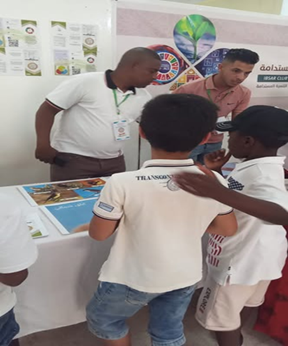
Recognising that marine protection originates inland, the University has implemented practical community actions in collaboration with key partners. As a proactive measure in environmental education, the University’s Ibsar Club for Sustainable Development participated in the local Cultural Festival’s ‘Reading in Celebration’ event on the International Day of the Child. Club members engaged young audiences by raising awareness about the migratory birds of the Oued Souf region, defining the child’s essential role in protecting wildlife, and detailing practical methods for environmental preservation. This initiative is crucial for cultivating future generations of environmental stewards who understand and act upon the interconnectedness of all ecosystems, including the essential aquatic resources.

Conclusion
The research and activities detailed herein demonstrate a committed and growing environmental stewardship by the University of El Oued. Overcoming the geographical challenge of its inland location, the University employs a strategic and effective approach centered on three pillars: Preventive Action, founded on the understanding that marine health is intrinsically linked to inland pollution control; Capacity Building, achieved through strategic investment in new analytical infrastructure; and Institutional Networking, which ensures the sustained effectiveness of environmental work through robust partnerships. These concerted efforts solidify the University of El Oued’s role as a proactive and substantial contributor to the global objectives of SDG 14.